How to Interpret a Place Name Without Overreading It
Learn how to interpret a place name by separating its historical meaning from the local feature it may describe, with a clear method for weighing clues.
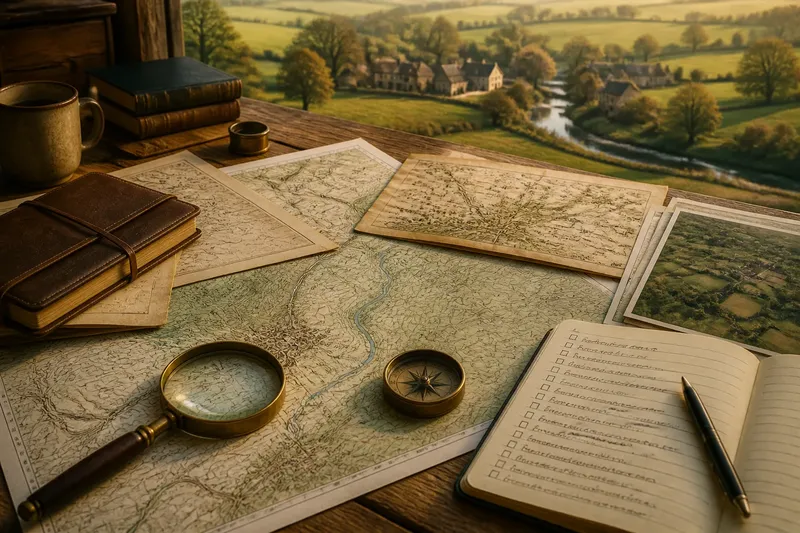
You see “ford” on an old map and glance toward the stream beside the village. The name seems to point to a crossing, but the watercourse has shifted and the old route is gone. To interpret a place name well, separate the word’s possible history from the particular feature you think it describes.
A place name is not a miniature map. Its elements may have changed in sound or meaning, may refer to land beyond the settlement center, or may preserve a feature no longer visible. The useful question is not simply “What does this word mean?” but “What supports this reading here?”
Meaning and identification
Start by distinguishing two claims. A language reference may show that an element can mean “hill,” “wood” or “stream.” That does not identify which hill, wood or stream—if any—gave a specific place its name.
For local identification, look for evidence that connects the proposed meaning to the place: recorded older forms, a credible account of the naming tradition, or a feature whose position makes sense. A modern dictionary gloss can suggest a question, but it cannot settle the local answer on its own.
Keep the evidence and the interpretation separate. An older map showing a watercourse is an observation; saying that it explains a name is an inference. That distinction lets you describe a plausible reading without turning it into a fact.
Read the name’s history
Spellings change as names are copied, standardized and adapted to different writing habits. A familiar-looking modern form may conceal an older pronunciation or make unrelated elements appear alike. If an interpretation depends on a particular word or language, historical forms matter more than a neat resemblance on today’s map.
Compare spellings from reliable local records or place-name references, where available. Notice which parts remain stable and which shift. If sources disagree, note what each one relies on rather than choosing the version that tells the most satisfying story.
It is not worth combing through a large dictionary for any word that happens to fit. That can produce plausible-sounding possibilities without helping you distinguish among them. Begin with the place’s language context and recorded forms, then consider only readings those sources can support.
Look beyond the center
A name may refer to a slope, hollow, wood edge or crossing outside the present built-up area. The feature may also have changed through drainage, construction or a shifted stream channel. A street map can hide small rises and hollows, while an older map may show landscape features that are no longer apparent.
Use maps as aids to locating clues, not as proof of a name’s origin. A topographic map can help you see contours; aerial imagery may show drainage patterns or tree lines; older maps can indicate where a feature was once recorded. Each source answers a different question, and none by itself confirms that the feature supplied the name.
Consider the surrounding area as well as the settlement label. A modest rise at the edge of a village may be more relevant than the nearest prominent summit. Equally, a feature that looks like a good match may be coincidental unless historical or linguistic evidence connects it to the name.
Compare nearby names
Neighboring names can preserve different views of the same area. One may refer to water, another to a slope, and a third to woodland. They need not have been coined at the same time or by the same people, so there is no need to force them into one unified description.
Say you encounter the invented names Brookfield and High Bank beside a stream. You note the watercourse on a current map, then check an older map and a topographic layer for a former channel and nearby rise. The resulting answer is limited but useful: the names could refer to different local features, while the maps alone cannot establish their origins.
Nearby names are most useful as prompts for further questions. Proximity may suggest a relationship, but it does not prove one, and modern administrative boundaries may not match the areas that older names described.
Questions about place names?
Does a name element identify one landform?
Usually, an element suggests a possible kind of meaning rather than pinpointing a particular feature. Historical forms and local evidence are needed to connect that meaning to a specific place.
Could a name refer to a vanished feature?
It could, but that possibility does not establish that the feature existed. Older maps and records may support the idea; if they do not, keep the explanation open.
Can I trust a familiar-looking spelling?
Treat the resemblance as a lead, not an answer. Earlier spellings and the relevant language history may show that the apparent match is accidental or that the meaning changed.
What if sources disagree?
Compare the evidence each source uses, such as historical forms or language context. If neither reading is better supported, report both as possibilities rather than selecting one for its appeal.
A useful evidence check
Before settling on an interpretation, make a short record of what you can actually point to. For each clue, decide whether it supports a linguistic possibility, a local identification, or neither:
- Check whether the proposed element appears in a credible language or place-name reference; if its meaning fits the recorded form, keep it as a candidate, but if not, set that reading aside.
- Check whether an older spelling supports the proposed word; if the form is consistent, use it as linguistic evidence, but if it conflicts, look for another reading.
- Check whether a relevant feature appears on a map or in a local record; if it does, note its location, but if it does not, avoid claiming that it is the feature named.
- Check a topographic map for the landform implied by the reading; if a plausible feature appears nearby, investigate the connection, but if not, broaden the search area or leave identification uncertain.
- Check whether an older map records a feature absent today; if it does, consider historical change as a possibility, but if it does not, do not invent a vanished feature to rescue the interpretation.
- Check whether nearby names support the same landscape reading; if they do, record the pattern as context, but if they point elsewhere, treat each name independently.
To interpret a place name responsibly, state what the word may mean, identify the local clues that support a possible reading, and say what remains unknown. A note beside the map with “observed or sourced” on one side and “possible explanation” on the other helps keep those claims distinct. That small habit makes a name more informative without asking it to explain an entire landscape.