A Watershed Walk for a Rainy Afternoon
A watershed walk turns a rainy afternoon into a clear way to see how nearby streets, parks, and streams share rainfall—and where their drainage divides.
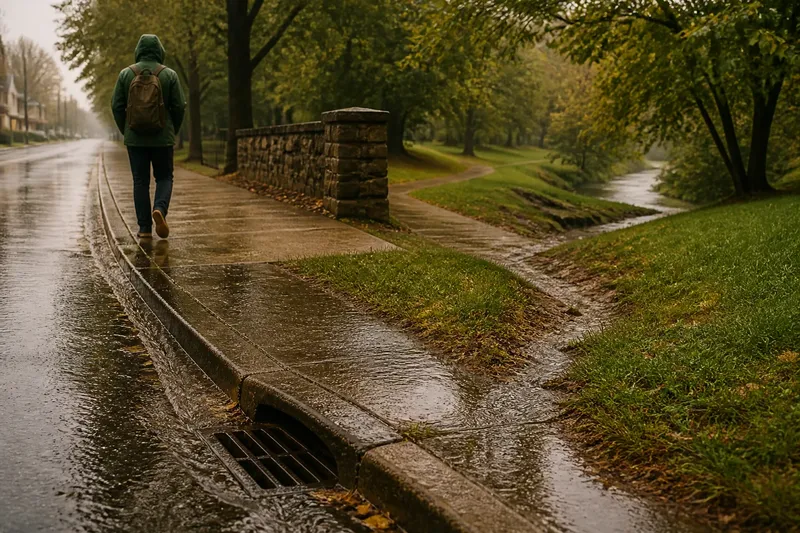
Rain taps the bus shelter while a narrow ribbon slips along the curb toward a storm drain. On a watershed walk, that small movement offers a close-up look at how rain travels through a neighborhood—and sometimes toward a different stream from the one nearby. You can begin on a familiar public sidewalk, without chasing every drop or stepping near moving water.
Read the runoff
A watershed is the land area that drains toward a shared outlet, such as a creek, lake, or river. Higher ground helps separate neighboring watersheds: rain falling on opposite sides can flow toward different channels.
In a built-up area, the visible route may not tell the whole story. A curb can steer runoff, while a storm drain sends it into a pipe. A wet patch shows where water is now; it does not, by itself, establish where all the rain from a street or park eventually goes.
Choose a safe stretch
Pick a familiar public route, such as a neighborhood sidewalk or park path where you can stop without blocking anyone. Wear shoes with reliable grip, and watch the ground as well as the water. Avoid flooded paths, slick banks, fast-moving streams, and any spot where traffic or poor visibility makes pausing unsafe.
As you go, look for clues that make sense together: water gathering at a low curb, a grassy channel leading away from a paved area, or a rise with ground falling off on either side. Note where the clues stop. A wall, building, or pipe may hide the next part of the drainage pattern.
- Check the curb. If water moves toward a grate, note the direction and continue along the public sidewalk; if the curb is dry or blocked, do not infer its usual flow from that spot alone.
- Check the ground beside the path. If a shallow hollow carries runoff onward, follow its direction from a safe distance; if it holds standing water, treat the route as uncertain and stay on firm ground.
- Check either side of a small rise. If the ground falls toward separate low areas, record a possible divide; if buildings or paving obscure the slope, mark the divide as unclear rather than choosing a side.
- Check for a visible ditch or creek. If a channel receives runoff, note the connection you can see; if its source or outlet is hidden, do not assume the surface route continues underground in a particular direction.
- Check for a barrier such as a curb or wall. If water turns beside it, record that local redirection; if the barrier hides where water goes next, leave the onward route unresolved.
- Check the surface. If runoff moves across pavement but slows in grass or leaf litter, note the contrast; if no water is moving, use the surface only as a clue, not as proof of a drainage route.
There is no need to inspect a grate, enter a drainage channel, or cross private land. If rain is heavy, visibility is poor, or a stream is rising, leave the observation for another day.
Link the clues
Say you start on a public street during a light shower and see water moving along the curb toward a grate. At a nearby park entrance, the pavement rises gently; beyond it, a shallow grassy hollow slopes toward a visible creek. You note those three observations, then mark the hidden pipe connection as unknown. The reasonable reading is that runoff on the park side appears to head toward the creek, while the grate’s destination cannot be determined from the walk alone.
This distinction matters because built drainage can carry water beneath streets or redirect it away from the surface slope. A short walk can reveal a local connection without establishing the full watershed. Treat each visible link as a clue, and keep the unseen stretches open.
Separate clues from guesses
Rain can make drainage easier to notice, but it can also distort the picture. A blocked grate may leave an unusual pool; a paved surface may send water along a route that differs from the broader shape of the land. A line of leaves against a curb shows where water collected, not necessarily where it usually flows.
Use plain notes: “water moving toward the grate” is an observation; “the whole neighborhood drains to the creek” is a larger claim. If the shower eases, compare active flow with its traces, such as damp soil or leaves caught in a hollow. If the route remains hidden, leave it unresolved.
Watershed walk questions?
What should I bring on a watershed walk?
A rain jacket, grippy shoes, and a small notebook or phone for brief notes are enough for a familiar public route. Keep your hands free when the path is wet, and skip the walk if conditions make footing or visibility unsafe.
Can I follow a watershed without a stream nearby?
Yes. Gutters, ditches, grassy hollows, and low points can reveal local runoff directions even when no stream is visible. Pipes or covered channels may carry water onward out of sight, so describe only the connections you can observe.
How can I spot a watershed divide?
Look for a rise or broad high area where the ground falls in different directions. Streets, walls, and drainage systems can obscure the natural shape, so a brief walk may suggest a divide without locating it precisely.
Should I check a map afterward?
A local topographic or watershed map can help place your observations within a larger drainage pattern. Compare it with your notes, but remember that a map may not show the curb, grate, or small hollow you noticed on the ground.
Keep the record simple
A quick sketch is useful if it separates what you saw from what remains unknown. Draw the public route, add arrows only where you observed moving water, and use question marks where a pipe, wall, or building hides the connection. Measuring slopes or marking every drain is not worth the effort for a quiet neighborhood walk.
For a watershed walk, the most useful habit is to name the clue and its limit together: water moved here, the ground appears to fall there, and the connection beyond the grate is unknown. The next time rain threads along a curb, that careful distinction can make a familiar street feel part of a larger landscape without turning a small observation into a claim the walk cannot support.